Die_Structure_Selection
Stamping Die Structure Selection Guide: Matching Product Characteristics Is Key
The choice of die structure directly affects stamping part quality, production efficiency, and manufacturing costs. Facing choices among single-operation dies, compound dies, progressive dies, and other options, how do you determine the optimal solution based on product characteristics? Industry experts provide systematic decision-making guidance.
Mainstream Die Structure Types
1. Single-Operation Dies
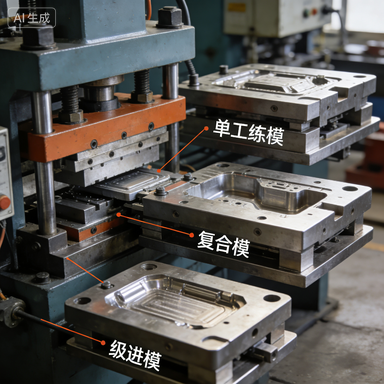
Each die set completes only one operation, with simple structure, short manufacturing cycle, and lower cost. Suitable for simple-shaped large parts or new product trial production stages. The disadvantage is that multiple die sets are needed in coordination, with inter-process handling increasing labor costs and precision consistency being difficult to guarantee.
2. Compound Dies
Two or more operations such as piercing and blanking are completed simultaneously at the same station in one die set. Production efficiency is relatively high, and workpiece internal/external concentricity is good. Suitable for small to medium-sized parts with high flatness requirements and symmetrical shapes. Die structure is relatively complex with greater maintenance difficulty.
3. Progressive Dies
Strip material passes through multiple stations in the die sequentially, with each station completing one operation, and the final station separating the finished part from the strip. Automation level is high, production efficiency is extremely high, suitable for large-volume production. However, die manufacturing cost is high and debugging cycle is long.
4. Transfer Dies
Combining characteristics of single-operation dies and progressive dies, using mechanical arms to transfer workpieces between stations. Suitable for large or three-dimensional complex-shaped parts, enabling automated production of complex operations such as deep drawing and forming.
Selection Decision Factors
1. Product Volume
For large-volume production, progressive dies are preferred. Although initial investment is large, the die cost amortized to each product is very low, with optimal overall benefits. For small and medium batch production, single-operation dies or simple compound dies are recommended to avoid excessive die costs.
2. Product Precision
For parts with high internal/external positional accuracy requirements, compound dies should be selected, completing multiple operations in one positioning to avoid cumulative errors. For parts with high flatness requirements, compound die blank holders can effectively prevent deformation.
3. Product Size
Large-sized workpieces are limited by press table size and stroke, usually only able to use single-operation dies. Small to medium-sized workpieces can choose compound dies or progressive dies based on volume and precision requirements.
4. Product Shape Complexity
For products with simple shapes and few operations, single-operation dies can meet requirements. For products with complex shapes and many operations, progressive dies can simplify process flow. Complex products with deep drawing can consider transfer dies.
5. Material Utilization
Progressive dies require carriers and scrap bridges, with material utilization generally 60%-75%. Compound dies directly blank, with material utilization reaching 80% or above. For precious materials, material utilization should be an important basis for die type selection.
Comprehensive Evaluation Method
Experts recommend using multi-factor weighted scoring method for die structure selection. First determine the weights of evaluation indicators such as volume, precision, efficiency, cost, and cycle time, then score each die structure solution item by item, and finally select the solution with the highest comprehensive score.
At the same time, full consideration should be given to practical factors such as existing enterprise equipment conditions, technical personnel capabilities, and successful experience with similar products in the past, avoiding blind pursuit of advancement while ignoring implementability.